
Instructional Information
Diagnosis is based on testing provided by the child’s school, an educational therapist, or child psychologist as well as Carola’s Informal Reading Inventory which includes screening for vision development.
Both are administered free of charge during the initial visit, in the student’s home. Subsequent instruction takes place at Carola’s home.
Learning Word Decoding
Every letter of the alphabet represents a sound. Beginning readers know their letter sounds.
First priority for beginning readers is to develop sight vocabulary, words that are recognized instantly because they are in the reader’s long-term memory. The easiest words are c-v-c words (consonant-vowel-consonant, ie, cap). Readers with strong sight vocabularies are more likely to figure out words they don’t know. For example, with this sentence, “The boy climbed up the tree”, they are likely to know the sight words ‘boy’, ‘the’, ’tree’, and ‘up’, and accurately guess the word ‘climbed’.
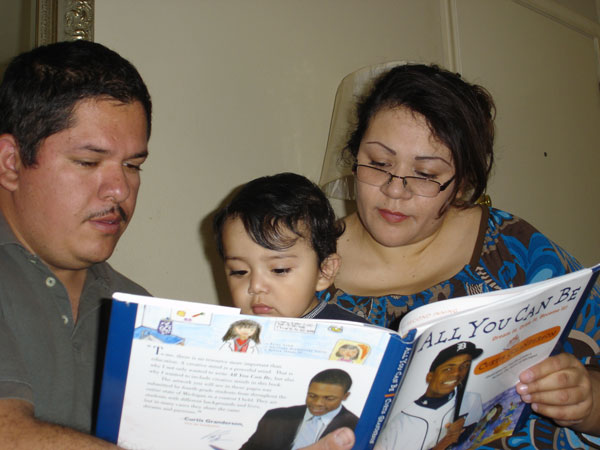
Books for early readers provide lots of pictures, which provide context for the words, so readers have clues for decoding. The same words are used repeatedly, to provide practice. Often a reader likes to reread the same book. This can be exasperating for parents, but rereading helps put words into long-term memory, and develops confidence. Eventually, the reader no longer needs pictures because they rely on sentences to provide context.
Language Experience Approach (LEA) is an effective way to learn new sight words. The student dictates a short story which the teacher or parent writes down, for the student to reread. The student is highly motivated to reread these stories because they are of high interest and are written with the student’s personal vocabulary. Carola prints out these stories for students to take home and practice.
Some approaches to teaching reading rely on ‘sounding out’ words, and do not always include reinforcement practice, for long-term memory (sight vocabulary). When presented with a sentence containing multiple unknown words, the expectation is to sound out each word. It’s difficult to get meaning from the sentence, because all of the reader’s energy has been spent on decoding. The result is poor comprehension because they are not reading with fluency.
Carola uses a variety of activities to reinforce words at the student’s current level in the continuum: sight word cards, word/picture matching games, workbooks, picture books and LEA.
Sample decoding continuum:
c-v-c words cap
silent ‘e’ long vowel cape
double vowels moon
blends spoon
double vowels with ble bread
Some readers have difficulty graduating from c-v-c words to harder words. This is often a sign that there are issues with processing. As words and sentences get longer; eyes fatigue easily because they are not working efficiently. Vision development rehabilitation corrects these issues by training the eyes to work together for smooth processing. To learn more about vision development, visit COVD.org, the website for Optometric Vision Development and Rehabilitation Association. Bellingham has two vision development centers.
Comprehension Continuum: (as appropriate to reading level)
Students become self-reliant in reading, researching information, and forming opinions as they progress through this continuum:
- Factual Recall and Information Skills (who, what, when, where, why, how)
- Generalizations (main idea, drawing conclusions, making judgments and predictions, summarizing)
- Organization Skills (sequencing, ordering, cause and effect, compare and contrast)
- Critical Thinking (inference, analysis, fact vs. opinion, author’s purpose and viewpoints)
Teacher input is highly valued for assessment of progress.
Lower Elementary students
Carola works with students who are below grade level. She works with them once or twice a week for one hour per session, with a minimum of 45 minutes of instructional time. As visual stamina improves, we take fewer breaks.
- Kindergardeners and first graders, who have experienced delays in language development work on readiness skills: listening, conversing, following verbal instructions, dictating stories, phoneme and grapheme recognition and reproduction, fine motor and eye/hand coordination.
- Second and third graders sometimes need to be taught strategies for decoding (figuring out words), making sense of short passages. Underlying vision development problems often manifest at this time because grade level words, sentences, and paragraphs become longer; the “visual input load” may feel overwhelming. In these cases, visual screening usually reveals eye fatigue. Vision therapy exams are then recommended.
When do four-year-olds benefit from reading readiness instruction?
Very rarely, preschool teachers make referrals to reading specialists. Early intervention provides exposure to language and readiness tasks, exposure a child may have missed, for whatever unique reasons, during their first four to six years of life.These early years are critical for language acquisition, and in turn, learning to read.
Before a child can read, the child needs to understand that alphabet letters are symbols for sounds. They cannot read unless they possess a strong understanding of conversational English and readiness skills.
Carola works with preschoolers who have legitimate readiness needs as observed by an educational therapist or preschool teacher.
Upper Grades
- Upper elementary students, junior and senior high school students who are near grade level or struggle to stay on grade level may need reinforcement of decoding skills, strategies for remembering what they read, organizational skills, or reinforcement of study skills and writing skills.
- Speed Reading: Students who are reading at sixth grade level or higher should be reading at 350 words per minute with at least 80% accuracy. Methods are learned quickly but require regular practice.
About Dyslexia
No program ‘cures’ dyslexia. People who are dyslexic will, most likely, always exhibit some traits. However, decoding skills and comprehension skills can be maximized with training.
Some people with neurological disorders or compromised executive thinking skills exhibit limited capacity for short-term memory of words or ideas. Assessments can span two or three sessions so that memory and cognitive functioning can be measured in real time. For example, when a student is unable to recall strategies and sight vocabulary from the prior lesson, reading instruction may not yet be appropriate.
Sometimes, after working with a student for a few sessions, learning differences appear, requiring the expertise of a specialist in neurology, special education, kinestheology, or visual perception. Sometimes reading instruction needs to wait until these other challenges are addressed.
Reading Instruction for Adults
There are many adults who do not know how to read. There are many reasons why they never learned. Some never went to school. Some learned to read a little, but not well.Adults are the fastest learners. They already have pieces of the puzzle.
They need someone to show them how to fit all the pieces together.
Undiagnosed visual development issues are often the main reason why some adults are illiterate. Carola screens adult students for vision development.